Airsoft Goggles: What ANSI Z87.1 Means and How to Choose
Quick Answer
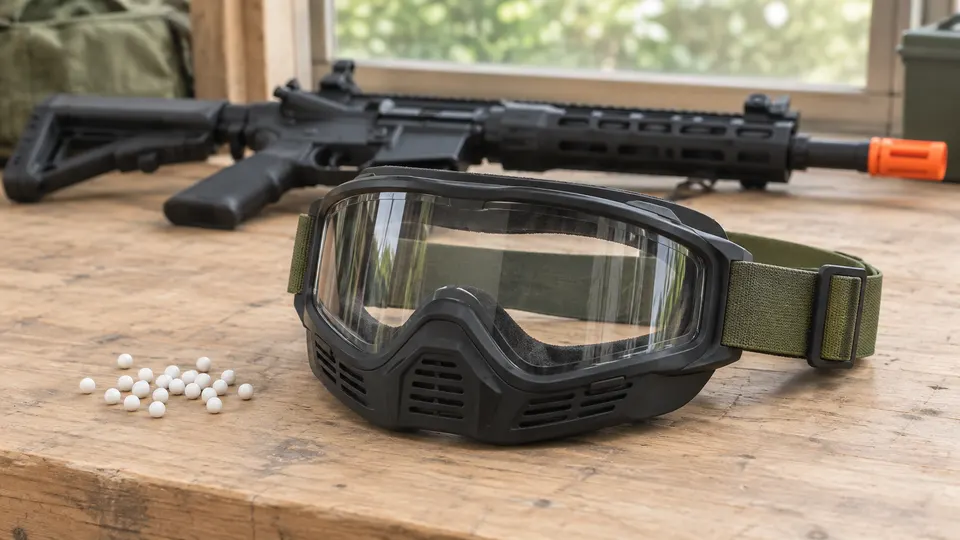
Choose full-seal goggles with a foam seal all the way around, a strap that holds them in place, and an impact rating stamped on the frame and lens. Z87+ (high impact) is the mark most US fields ask for; ASTM F2879 is the airsoft-specific standard. Avoid sunglasses, open shooting glasses and mesh-only eye protection, and pick a thermal or fan lens if you play indoors or in cold weather.
On this page
- What Does ANSI Z87.1 Mean on Airsoft Goggles?
- Why Do Fields Insist on Rated, Sealed Goggles?
- Full-Seal vs Mesh vs Shooting Glasses: Which Should You Choose?
- How Do You Stop Airsoft Goggles From Fogging?
- Can You Wear Airsoft Goggles Over Prescription Glasses?
- When Should You Replace Airsoft Goggles?
- Frequently Asked Questions
- Our Take
- Sources
Key Takeaways
- Look for sealed goggles marked Z87+ (the high-impact level of ANSI/ISEA Z87.1) on both lens and frame; plain "Z87" is the basic impact level.
- ASTM F2879 is the standard written specifically for airsoft eye protection against 6 mm BBs, and the American Academy of Ophthalmology lists it for airsoft.
- Sunglasses, prescription glasses, shop glasses with gaps and mesh-only goggles are not enough at most fields.
- Fog is the main reason players are tempted to lift their goggles; a thermal dual-pane lens or a fan fixes it, and goggles stay on until you reach the safe zone.
- Replace goggles after a hard hit that cracks or deeply marks the lens, or when the seal or strap wears out.
What Does ANSI Z87.1 Mean on Airsoft Goggles?
ANSI/ISEA Z87.1 is the main US standard for occupational eye and face protection: safety glasses, goggles and face shields worn at work. It has two impact levels, and the difference matters for airsoft.
- Z87 (basic impact). The eyewear must survive a drop ball test. HexArmor, a safety equipment maker, describes it as a steel ball about one inch in diameter and roughly 2.4 oz, dropped from a height of 50 inches onto the lens [1].
- Z87+ (high impact). The eyewear goes through a much tougher set of tests, including a high-velocity test in which a ¼-inch steel ball is fired at 20 specified impact points. HexArmor gives the speeds as 102 mph for safety glasses and 170 mph for safety goggles.
For airsoft, the plus sign is the part to look for: Z87+ means the eyewear passed the high-velocity impact tests, not just the drop ball. Fields that publish their rules often ask for it directly. Fox Airsoft in Parker, Colorado, for example, states that goggles must be full-seal, have a retention strap and be stamped Z87+ [2].
Where does ASTM F2879 fit?
ASTM F2879 is the "Standard Specification for Eye Protective Devices for Airsoft Sports". Its scope covers eye protection designed for players using 6 mm airsoft projectiles, and its stated aim is to reduce injury to the eye and the tissue around it from impact and penetration [3]. The scope also says it does not necessarily protect any other part of the head, which is why face protection is a separate decision. The same scope notes that for target practice with a paper or gel target and a backstop that stops ricochets, shooters may wear eyewear meeting ANSI Z87.1 instead.
The American Academy of Ophthalmology (AAO) lists ASTM F2879 as the eye protector standard for airsoft sports, and advises choosing polycarbonate protective eyewear with the ANSI Z87.1 mark on the lens or frame [4]. Many goggles sold for airsoft carry the Z87+ mark rather than an F2879 claim, and fields generally accept either, so read your field's rules and the label together.
Why Do Fields Insist on Rated, Sealed Goggles?
Because airsoft eye injuries are real and can be permanent. The AAO says that since 2010 the number of people admitted to hospital for eye injuries from air guns has increased by 600%, and that ski goggles and sunglasses are not safe with air guns because they can shatter when hit [5].
A 12-year review of non-powder toy gun eye injuries at a Paris eye emergency department counted 324 injuries. BB guns and airsoft guns were frequently responsible for injuries to the front of the eye, and were linked to bleeding inside the eye (14.7%) and retinal bruising, called commotio retinae (21.1%) [6]. An eye hit by a BB is a medical emergency: stop playing, call for the marshal and get the player to an eye doctor or emergency room.
The seal matters as much as the lens. Fox Airsoft's eyewear page puts it plainly: any gap between your eye protection and your face is where BBs will end up [7]. BBs ricochet off walls, barricades and branches, so they arrive from the side and from below, not just straight ahead.
Full-Seal vs Mesh vs Shooting Glasses: Which Should You Choose?
For a new player, full-seal goggles are the safe default. The table compares the common styles.
| Style | Seal around the eyes | Impact rating | Typical field stance | Notes |
|---|---|---|---|---|
| Full-seal goggles (Z87+ lens and frame) | Yes, foam seal all round | Yes | Accepted almost everywhere | The default; pick a thermal or fan model for fog |
| Full-face mask with a rated lens | Yes | Yes (lens) | Accepted; often required for minors or indoors | Adds teeth, ear and face cover |
| Shooting glasses (Z87+) | No, open at sides | Yes | Often refused because of gaps | Fine for target practice, not games |
| Mesh goggles or mesh-eye masks | Varies | No lens rating | Discouraged or refused by many fields | BB fragments can pass through |
| Sunglasses, prescription or ski goggles | No | No | Not eye protection | Can shatter when hit |
Mesh is the style that causes the most arguments. It does not fog, which is why some players like it, but Fox Airsoft says mesh should be avoided because a BB can shatter on impact, and the field turns away masks with untested lenses or metal mesh [7]. A case report from University of Florida Health describes a boy whose eye was injured by a plastic airsoft BB that came through the steel mesh of a protective mask; he had reduced vision, a corneal abrasion and bleeding in the front of the eye, and the authors argue for polycarbonate eye protection [8]. Treat mesh as face protection only, never as your eye protection.
When you shop, check five things: the rating mark on both frame and lens, a continuous foam seal that touches your face with no daylight showing, a strap you can tighten, vents that are indirect or covered, and room inside for glasses if you wear them. The gear selector lists full-seal goggles as a must-have for every kind of field, and the CQB starter loadout pairs them with full-face protection for indoor arenas. Outdoors, the outdoor starter loadout uses sealed goggles with a mesh lower mask, which keeps the mesh away from the eyes.
How Do You Stop Airsoft Goggles From Fogging?
Fog forms when warm, moist air from your face and breath meets a lens that is cooler than it is. Running, cold mornings, humid indoor arenas and a lower-face mask that pushes breath upward all make it worse. Fog matters for safety, not just comfort: a fogged lens tempts players to lift their goggles, and goggles stay on past the safe-zone line even when they are foggy or itchy. Fox Airsoft's safety briefing says exactly that [2].
Practical steps that help:
- Choose a thermal (dual-pane) lens. The sealed air gap keeps the inner pane closer to face temperature. The gear selector flags this for indoor arenas, where warm, humid air is common.
- Consider a fan model if you fog easily or wear glasses underneath. Carry spare batteries.
- Put goggles on before you start moving and let them settle to your face temperature, instead of pulling them on hot and sweaty.
- Use anti-fog products only as the goggle maker directs. Some lenses have factory coatings that the wrong cleaner or a rough cloth can damage.
- Vent your breath downward. A lower-face mask that lets breath escape below, rather than up into the goggle, reduces fog.
- Carry a spare lens or second pair in your bag for long outdoor days.
Can You Wear Airsoft Goggles Over Prescription Glasses?
Yes, but plan for it. Your everyday glasses are not eye protection: the AAO notes that eyeglasses do not protect against impact and that some can shatter, causing more injury [4]. There are three common routes:
- Over-the-glasses (OTG) goggles. These have a deeper frame and cut-outs for the arms of your glasses. Try them with your own frames, and check the seal still closes at the temples.
- Prescription inserts. Some goggles accept a clip-in frame that holds prescription lenses behind the main lens. The AAO notes that some protective glasses and goggles are available with prescription lenses, while others fit over your glasses.
- Contact lenses with a standard goggle, if your eye doctor agrees they suit you.
Glasses wearers fog more because there are two surfaces to keep warm, so a fan or thermal lens is worth more to you than to most players.
When Should You Replace Airsoft Goggles?
Goggles are not forever. Replace the lens or the whole goggle when:
- The lens cracks, chips or shows a deep pit from a hit. A damaged lens may not hold up to the next one.
- Scratches or haze make it hard to see clearly, especially at night or in dim arenas.
- The foam seal is torn, compressed or peeling, leaving gaps.
- The strap or its clips are stretched or broken, so the goggle can be knocked off.
- The maker's guidance says so. Many manufacturers publish lens replacement advice; follow it and use their own replacement lenses so the rating still applies.
Rental goggles at fields are usually checked and cleaned, which is one reason renting for a first game is reasonable. If you are buying, the beginner all-rounder loadout and the loadout quiz show where goggles sit in a first kit.
A short note on the rest of your kit
If goggles are your first purchase, a replica may be the next. In the US, the federal marking rule for toy, look-alike and imitation firearms requires a blaze orange plug recessed no more than 6 mm into the barrel, or one of the other approved markings; it is now issued by the Consumer Product Safety Commission at 16 CFR Part 1272 [9]. The older NIST version of the same rule, 15 CFR Part 272, was removed on February 19, 2026 because the CPSC rule replaced it [10]. States and cities can add their own rules, and most sellers and fields require players to be 18 or older (or to have a parent or guardian present), so check your state and city rules. Carry replicas to the field in a closed case, keep them out of sight on the way, and only use them at an organized field. Our safety and laws summary collects these basics.
Gear for this guide
Airsoft Goggles-Tactical Goggles Anti Fog ANSI Z87.1
Check price on AmazonLancer Tactical AERO Airsoft Goggles
Check price on AmazonLancer Tactical Airsoft Goggles
Check price on Amazon
Frequently Asked Questions
Are Z87 safety glasses enough for airsoft?
Usually not. Plain Z87 is the basic impact level, and open safety glasses leave gaps at the sides and bottom where ricochets get in. Most fields that publish rules ask for sealed goggles with a high-impact Z87+ rating, or eyewear meeting the airsoft standard ASTM F2879.
Can I use paintball goggles or a paintball mask for airsoft?
Only if the lens and seal meet your field's rules. A paintball mask covers the face well, but check that the lens carries an impact rating your field accepts and that the goggle part seals around the eyes. Ask the field before you go.
Are mesh goggles allowed at airsoft fields?
It depends on the field, and many discourage or refuse them. Mesh does not fog, but BB fragments can come through, and a published case report describes an eye injury through a steel mesh mask. Use mesh for the lower face, not the eyes.
What should I do if my goggles get hit hard?
Keep them on until you reach the safe zone, then inspect the lens for cracks, chips or deep pits. If you see damage, swap the lens or use another pair before you play again. If a BB ever reaches an eye, treat it as an emergency and get medical help.
Our Take
We think goggles are the one purchase a new player should not economize on, and that the extra spent on a thermal or fan lens is money well spent, whether you shop budget, mid-range or premium. In our view the rating mark gets checked at the gate but fog is what actually defeats eye protection, because it pushes people to lift their goggles mid-game. So our advice is simple: buy sealed, Z87+ or F2879 goggles that fit your face (and your glasses), fix fog before you walk onto the field, and replace a damaged lens without arguing with yourself. Then use the gear selector to plan the rest.
Sources
- Safety eyewear: What do lens markings and ANSI Z87+ mean?. HexArmor.
- Safety Briefing. Fox Airsoft.
- Standard Specification for Eye Protective Devices for Airsoft Sports (F2879-22(2026)). ASTM International, 2026.
- Safety Glasses: How to Prevent Blinding Eye Injuries. American Academy of Ophthalmology.
- Eye Injuries From Paintball Guns, Air Guns and Other Projectile Toys. American Academy of Ophthalmology.
- Incidence and Outcomes of Eye Trauma Associated With Recreative Use of Nonpowder Toy Guns: A 12-Year Retrospective Study. Dentel A, et al, 2024.
- Approved Eyewear. Fox Airsoft.
- Ocular injury from plastic airsoft bullet through protective steel mesh mask. Zhou Y, Osuji E, Beal C, 2022.
- 16 CFR Part 1272: Marking of Toy, Look-Alike, and Imitation Firearms. eCFR.
- Eliminating Obsolete Marking Requirements for Toy, Look-Alike, and Imitation Firearms. Federal Register.
Airsoft rules differ by field, city and state. Always follow your field's safety rules and check local laws on buying, carrying and transporting replica guns. We do not list prices; check the current price and the maker's specifications on the product page. Spotted an error? Tell us.
More Airsoft Guides
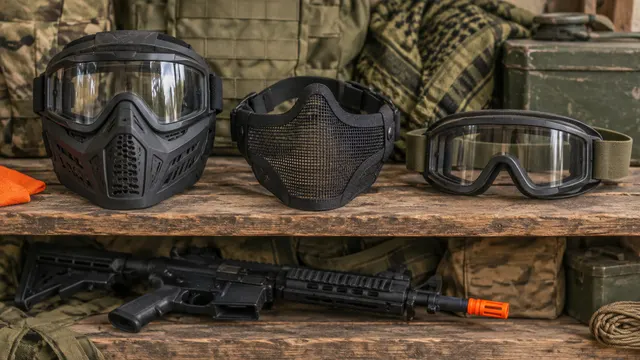
Airsoft Face Protection: Full-Face vs Mesh Lower Masks
Full-face masks vs goggles with a mesh lower mask: what each covers, field rules for under-18 players, why mesh never replaces goggles, plus ears and helmets.
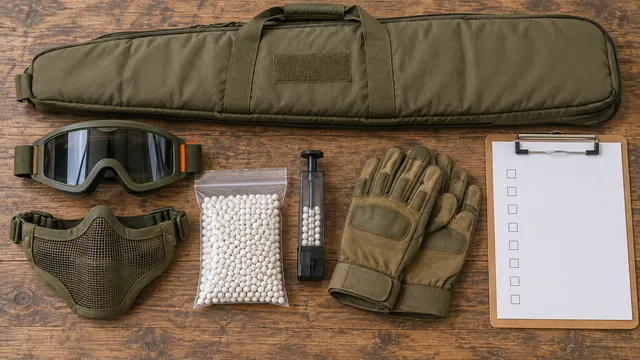
Airsoft Gear Checklist: What to Buy First (and What to Skip)
A priority-ordered airsoft gear checklist: protection first, then gun, BBs, charger and case, then clothing and a rig, plus what to rent and what to skip early.
Airsoft for Beginners: Everything to Know Before Your First Game
New to airsoft? How games work, booking a field, waivers and age, rated goggles, rentals, the chrono, hit calling, MED and etiquette, plus a first-day timeline.
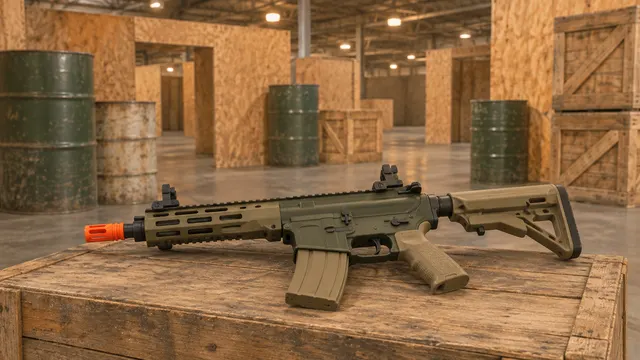
CQB Airsoft Gear: What You Need for Indoor Fields
What to bring to an indoor CQB airsoft field: full-seal goggles, a full-face mask, a compact AEG, knee pads and a low-profile rig, plus indoor limits and rules.
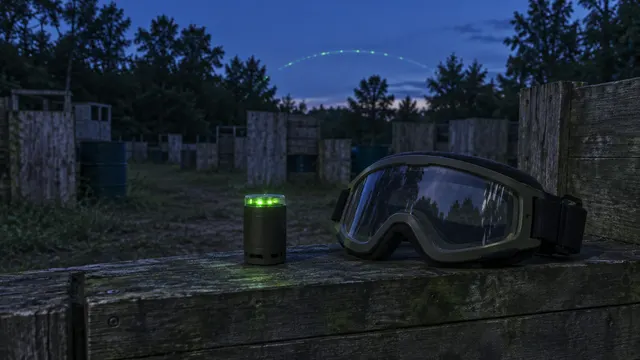
Night Airsoft Gear: Tracers, Lights and Staying Safe
What to bring to a night airsoft game: clear sealed goggles, a tracer unit and glow BBs, a red dead light, a light used by field rules, plus how tracers work.
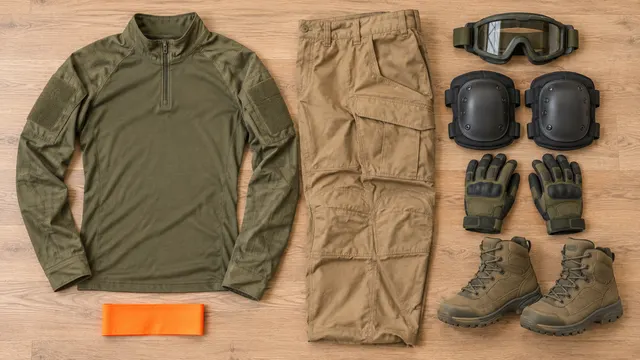
What to Wear to Airsoft: A First-Game Clothing Guide
What to wear to your first airsoft game, head to toe: long sleeves, layers, boots, gloves and knee pads, plus hot and cold weather tips and what to leave home.