Airsoft FPS Limits Explained: Field Rules, Joules and MED
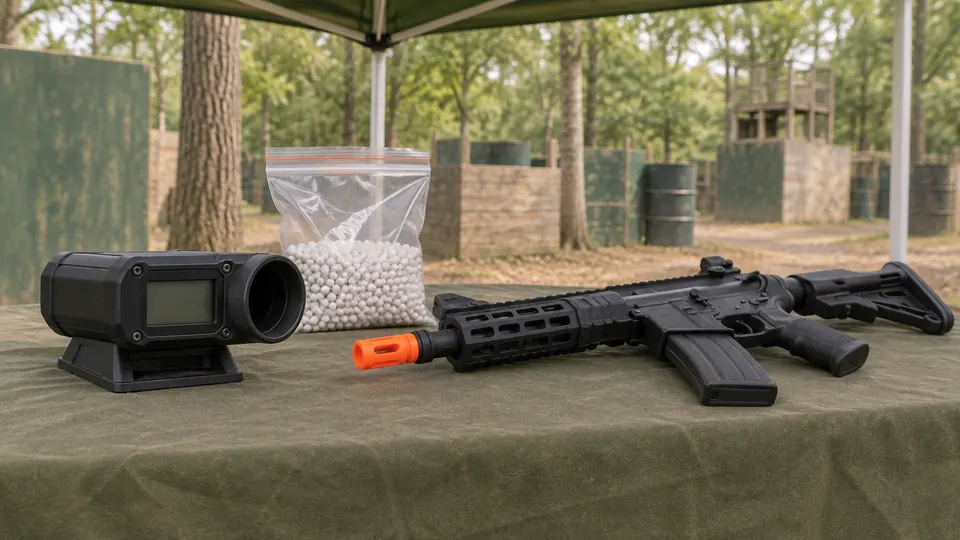
Quick Answer
Airsoft fields cap muzzle velocity, usually measured in FPS with a stated BB weight or directly in joules. Typical published limits are about 1.1-1.55 joules for pistols and rifles (roughly 340-410 FPS on 0.20 g BBs), about 2 joules for semi-auto DMRs and about 3 joules for bolt-action rifles. Stronger classes must keep a minimum engagement distance (MED), often 75-125 feet. Limits vary by field, so check yours before you go.
On this page
Key Takeaways
- FPS (feet per second) is the BB's speed at the muzzle; joules measure its energy, which also depends on BB weight.
- There is no single legal FPS limit for airsoft in the US: each field sets its own, so always read your field's rules.
- Published examples cluster around 1.1-1.55 J for pistols and rifles, about 1.9-2.0 J for semi-only DMRs and 2.8-3.0 J for bolt-action rifles.
- Higher-powered classes come with a minimum engagement distance, typically 75 ft for DMRs and 100-125 ft for bolt-action rifles.
- A gun that reads over the limit does not play. Never modify a gun to shoot harder; buy a stock gun that fits your field.
What Do FPS and Joules Actually Measure?
FPS is speed: how many feet per second the BB travels as it leaves the barrel. Joules are energy, and energy depends on both speed and mass. Fox Airsoft, which runs a field in Colorado, gives the standard physics formula on its calculator page: energy in joules equals 0.5 times the BB mass in kilograms times the velocity in meters per second, squared [1]. A 0.20 g BB at 400 FPS carries about 1.49 joules.
That is why an FPS number means nothing without the BB weight it was measured with. The same gun fires a lighter BB faster and a heavier BB slower. For spring and electric guns, Fox Airsoft explains that muzzle energy stays about the same while FPS drops as BB weight goes up. Gas and HPA (high-pressure air) guns can behave differently: heavier BBs may pick up extra energy, an effect players call "joule creep."
Many fields still talk in FPS because it is what a chronograph shows. Wilde West Acres, for example, writes its limits both ways: under 1 joule is "328 FPS with a .20 Gram BB," and its rifle cap of 1.14 joules is "350 FPS with a .20 Gram BB" [3]. Other fields skip FPS and simply state joules, measured with a fixed BB weight.
What Are Typical Airsoft FPS Limits by Gun Type?
Fields sort guns into classes, and each class gets its own cap. Two published rule sets show the pattern. Xtreme Airsoft chronos with 0.32 g BBs and allows 1.1 J for pistols, 1.55 J for rifles, SMGs and LMGs, 1.9 J for semi-auto DMRs and 2.81 J for bolt-action sniper rifles [2]. Fox Airsoft lists its FAF field at 1.5 J for AEGs, pistols and shotguns, 1.3 J for HPA guns, 2.0 J for an AEG DMR and 3.0 J for spring or HPA bolt-action rifles [1].
Event rules written in FPS look similar once you convert them. Evike's rules for its Airsoft Nation event pass guns under 400 FPS with 0.20 g BBs, flag 400-410 FPS for a second look and refuse anything over 410 FPS [4]. Indoor and close-range venues often sit lower; Wilde West Acres caps rifles at 350 FPS on 0.20 g.
| Gun class | Example published limit | Common extra rules |
|---|---|---|
| Pistol | 1.1 J (Xtreme), 1.5 J (FAF) | Often no MED |
| Rifle / AEG / SMG | 1.5-1.55 J; under 400 FPS on 0.20 g (Evike event) | Semi-auto only at close range |
| LMG / support | 1.55 J (Xtreme) | Longer MED on full auto |
| DMR | 1.9-2.0 J | Semi-auto only, 75 ft MED, often a magnified optic |
| Bolt-action sniper | 2.81-3.0 J | Bolt-action only, 100-125 ft MED |
Use the table to understand the categories, not to pick a number. Your field's posted limit is the only one that counts on game day. A stock starter rifle usually sits in the standard rifle class, which is why the CQB starter loadout and outdoor starter loadout both build around an unmodified retail gun.
What Is Minimum Engagement Distance (MED)?
MED is the closest distance at which you may shoot another player with a given gun. Stronger classes get longer distances, because a hit at close range hurts more. Inside the MED of your gun, you do not fire it at a player; you switch to a sidearm or follow the field's surrender rule.
The published numbers again follow a pattern. Xtreme Airsoft sets no MED for pistols, 10 ft for rifles on semi-auto and 40 ft on full auto, 75 ft for DMRs and 125 ft for bolt-action rifles. FAF asks for semi-auto within 10 ft for standard guns, 75 ft for DMRs and 100 ft for bolt-action rifles, and requires a magnified optic on both long-range classes. Wilde West Acres uses a 10 ft MED once a replica shoots over 1 joule. Evike's event rules use a "parlay" call: at 15 feet or less in front of you, one player calls it and the other backs off.
Practical habits that follow from MED rules:
- Know your class before the game starts. The chrono marshal will tell you if your gun counts as a standard rifle, a DMR or a sniper rifle.
- Carry a backup for close range if you play a DMR or bolt-action rifle. That is why the gear selector recommends a sidearm for the sniper role.
- Learn to judge distance. Pace out 10, 75 and 100 feet once at home so you can recognize them under pressure.
How Does Chrono Work at Check-In?
Chrono is short for chronograph, the device that measures how fast the BB leaves the barrel. At most fields a staff member runs it before the first game; Wilde West Acres, for example, says a staff member must be present and that all replicas are chronographed in joules. The marshal fires a few shots through the chronograph with the field's own BBs, reads the number and marks the gun as passed, often with a tag or sticker.
Points worth knowing before you arrive:
- Bring the gun in a closed case and keep it bagged in the parking lot. Uncase it only at the safe zone or the chrono table.
- Expect the field's BB weight. Xtreme Airsoft uses 0.32 g, Evike's events use 0.20 g or 0.25 g, and the result only compares fairly at that weight.
- Wear your goggles at the chrono table if the field asks; you are near guns being fired. Sealed eye protection rated to ANSI Z87.1 is the baseline, and Evike's rules say eye protection must have a face seal and a secure strap. Our guide to airsoft goggles and Z87.1 explains the ratings, and the face protection guide covers the lower face.
- Accept the result. A gun that reads over the limit sits out. Fields may re-check guns during the day.
Why do "hot" guns get banned?
A "hot" gun is one that shoots over the field's limit. Fields ban them because the limits exist to prevent injuries, especially to eyes and faces. The American Academy of Ophthalmology warns that airsoft BBs can rupture an eyeball, and reports that hospital admissions for eye injuries from air guns have risen by about 600% since 2010 [5]. The AAO also says ski goggles and sunglasses are not safe for air gun use, because they can shatter. A gun that passes chrono is still not safe without sealed, impact-rated goggles.
If your gun reads hot, do not try to adjust it yourself to get through. Ask the field what they suggest, use a rental for the day, or buy a stock gun from a retailer that fits the field's class. Our editorial rule is simple: we never cover modifications that change velocity.
What Should a Beginner Do About FPS Limits?
For a first game, FPS limits are mostly the field's job. Many fields rent guns that already fit their rules, and the quiz points first-timers to renting before buying. When you are ready to buy, follow three steps:
- Read your home field's rules page and write down its limit, the BB weight it uses and its MEDs.
- Pick a stock retail gun in the standard rifle class unless you know you want a DMR or sniper role. A beginner all-rounder loadout works at most fields.
- Buy good BBs in the weight your field uses for chrono and play. Seamless, polished BBs feed and fly more consistently, and many outdoor fields require biodegradable BBs.
A short legal note, since this guide is about guns. In the US, toy, look-alike and imitation firearms must carry an approved marking, most often a blaze orange tip; the federal rule is now at 16 CFR Part 1272, which took over from 15 CFR Part 272 [6]. State and city rules differ, and many retailers and fields set 18+ or require a parent or guardian; check yours. Carry the gun in a closed case, never openly where people could mistake it for a real firearm, and use it only at an organized field. This is general information, not legal advice; check your state and city rules and the safety and laws summary.
Gear for this guide
Elite Force Premium Biodegradable 6mm Airsoft BBS Ammo
Check price on AmazonAim Green Biodegradable Airsoft BBS
Check price on AmazonElite Force Premium 6mm Airsoft BBS Ammo
Check price on Amazon
Frequently Asked Questions
Is 400 FPS too much for airsoft?
It depends on the field and the BB weight. Evike's Airsoft Nation event rules pass guns under 400 FPS on 0.20 g BBs, which is about 1.49 joules. Some indoor or close-range venues cap rifles lower, such as 350 FPS on 0.20 g at Wilde West Acres. Check your field's posted limit.
Why do some fields use joules instead of FPS?
Joules measure energy, which accounts for BB weight. A field that caps energy can test with heavier BBs and still compare guns fairly. Xtreme Airsoft and FAF both publish limits in joules and chrono with 0.32 g BBs.
What BB weight is used at chrono?
The field decides. Published examples include 0.20 g, 0.25 g and 0.32 g. Spring and electric guns read lower FPS with heavier BBs at about the same energy, so compare readings only at the weight the field names.
What happens if I am closer than the MED?
You do not fire that gun at the player. Switch to a sidearm, use the field's surrender or "parlay" call, or move back. Rules differ, so ask at the safety briefing.
Our Take
We think beginners worry about FPS more than they need to. The useful mental model is simple: fields sort guns into classes, each class has an energy cap and a minimum distance, and both exist to protect eyes and faces. In our view, the right move is to rent first, read your home field's rules page, then buy a stock gun that sits comfortably in the standard rifle class. Spend the effort on sealed, Z87.1-rated goggles and good BBs instead of chasing numbers. If a field's limits feel confusing, ask the staff at check-in; they answer the same questions every weekend. Build your list in the gear selector.
Sources
- Airsoft FPS Calculator: Convert FPS, BB Weight, and Joules. Fox Airsoft.
- Gun Power and Engagement Distances. Xtreme Airsoft.
- Rules. Wilde West Acres.
- Airsoft General Rules. Evike.
- Combating Eye Injuries from Air Guns. American Academy of Ophthalmology.
- 16 CFR Part 1272: Marking of Toy, Look-Alike, and Imitation Firearms. eCFR.
Airsoft rules differ by field, city and state. Always follow your field's safety rules and check local laws on buying, carrying and transporting replica guns. We do not list prices; check the current price and the maker's specifications on the product page. Spotted an error? Tell us.
More Airsoft Guides
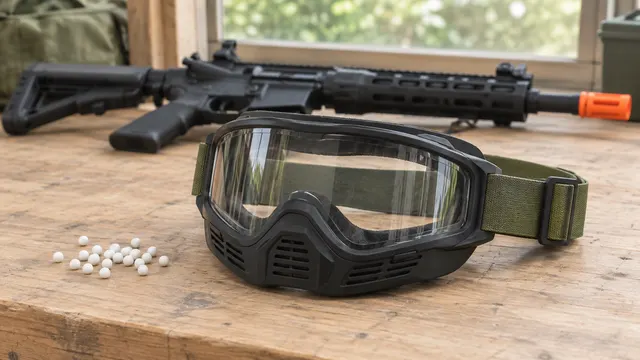
Airsoft Goggles: What ANSI Z87.1 Means and How to Choose
What the ANSI Z87.1 and Z87+ marks mean on airsoft goggles, where ASTM F2879 fits, full-seal vs mesh vs glasses, how to stop fog, and when to replace a pair.
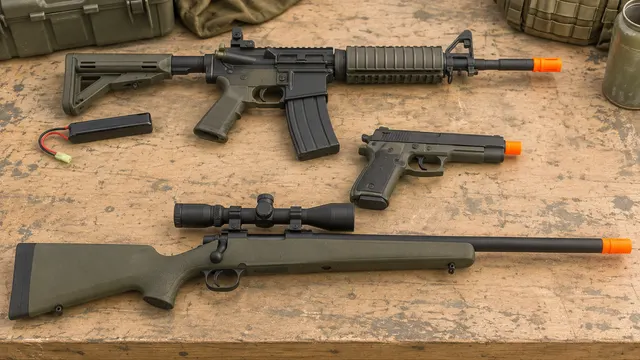
AEG vs Gas vs Spring Airsoft Guns: Which Should a Beginner Buy?
How electric (AEG), gas and spring airsoft guns work, how they cope with cold, what batteries and upkeep they need, and which one suits a first-time player.
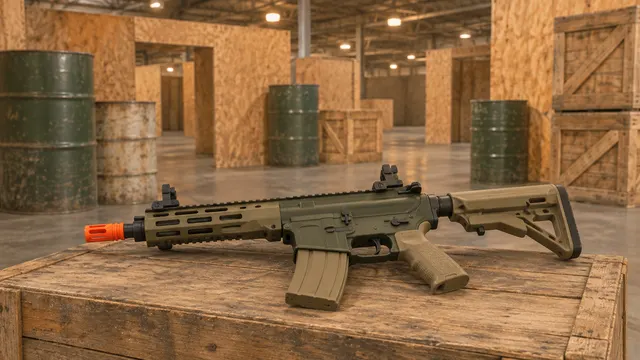
CQB Airsoft Gear: What You Need for Indoor Fields
What to bring to an indoor CQB airsoft field: full-seal goggles, a full-face mask, a compact AEG, knee pads and a low-profile rig, plus indoor limits and rules.
Airsoft for Beginners: Everything to Know Before Your First Game
New to airsoft? How games work, booking a field, waivers and age, rated goggles, rentals, the chrono, hit calling, MED and etiquette, plus a first-day timeline.
Airsoft Gear Checklist: What to Buy First (and What to Skip)
A priority-ordered airsoft gear checklist: protection first, then gun, BBs, charger and case, then clothing and a rig, plus what to rent and what to skip early.
Night Airsoft Gear: Tracers, Lights and Staying Safe
What to bring to a night airsoft game: clear sealed goggles, a tracer unit and glow BBs, a red dead light, a light used by field rules, plus how tracers work.