Airsoft Orange Tip Laws: Federal Rules, State Limits and Age
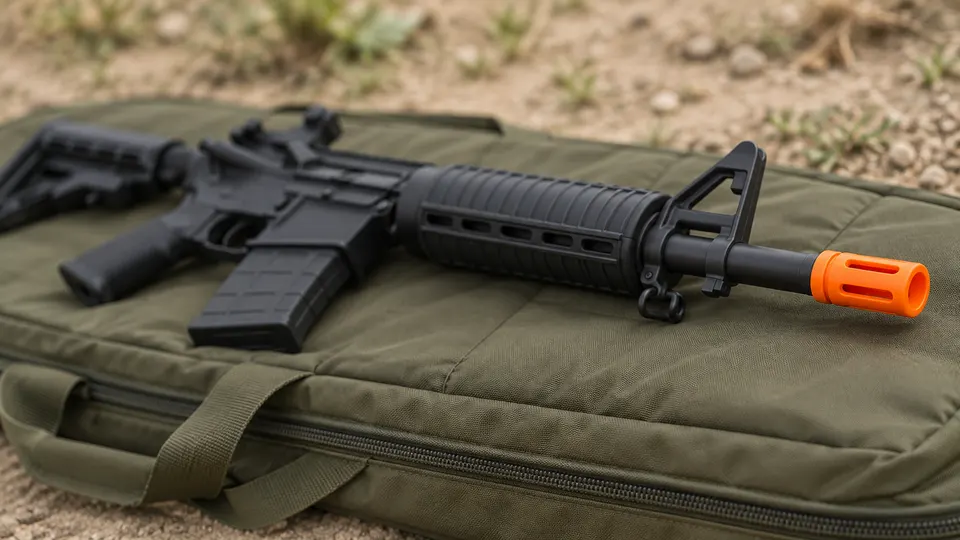
Quick Answer
US federal rules require toy, look-alike and imitation firearms to carry an approved marking, most often a blaze orange plug in the muzzle recessed no more than 6 mm. The rule now lives at 16 CFR Part 1272 (CPSC); 15 CFR Part 272 held the same text until 2026. States can add requirements, such as California's fluorescent trigger guard and bands for airsoft guns. Keep the tip intact, transport in a closed case, and check state and city rules.
On this page
Key Takeaways
- The federal marking rule is now 16 CFR Part 1272, run by the CPSC; the older 15 CFR Part 272 was removed on February 19, 2026, with the same marking options.
- The approved markings are a blaze orange muzzle plug recessed no more than 6 mm, a blaze orange band at least 6 mm deep around the barrel, a fully transparent body, or an all-over bright color.
- States add rules: California requires fluorescent markings on airsoft guns beyond the orange tip, and Minnesota makes it a crime to display a replica firearm in a threatening manner.
- Many retailers and fields set 18+ or require a parent or guardian; check the policy of yours.
- Keep the marking intact, carry the gun in a closed case, and uncase it only at an organized field.
What Does the Federal Orange Tip Rule Say?
The core prohibition is one sentence. The current regulation states: "No person shall manufacture, enter into commerce, ship, transport, or receive any toy, look-alike, or imitation firearm ('device') covered by this part as set forth in § 1272.1 unless such device contains, or has affixed to it, one of the markings set forth in § 1272.3, or unless this prohibition has been waived by § 1272.4" [1].
Until this year, the same requirement sat in a Commerce Department regulation, 15 CFR Part 272. Its § 272.2 used nearly identical words, with the markings "approved by the Secretary of Commerce" [2]. NIST removed Part 272 effective February 19, 2026, explaining that the CHIPS and Science Act of 2022 had moved the authority to the Consumer Product Safety Commission, and that CPSC's 16 CFR Part 1272 now holds "the new, operative marking requirements" [3]. Many older articles and product pages still cite Part 272; the marking options did not change.
The approved markings, in the regulation's own words, are:
- (a) "A blaze orange (AMS STD 595A-17 color 12199) or orange color brighter than that specified by the AMS standard color number, solid plug permanently affixed to the muzzle end of the barrel as an integral part of the entire device and recessed no more than 6 millimeters from the muzzle end of the barrel."
- (b) A blaze orange marking "permanently affixed to the exterior surface of the barrel, covering the circumference of the barrel from the muzzle end for a depth of at least 6 millimeters."
- (c) "Construction of the device entirely of transparent or translucent materials which permits unmistakable observation of the device's complete contents."
- (d) "Coloration of the entire exterior surface of the device in white, bright red, bright orange, bright yellow, bright green, bright blue, bright pink, or bright purple, either singly or as the predominant color in combination with other colors in any pattern."
Two more parts matter. A waiver exists only for devices "used only in the theatrical, movie, or television industry." And § 1272.5 says the federal provisions supersede state or local laws that require markings "inconsistent with" them. That does not stop states from regulating other things, as the next sections show.
Does the federal rule cover airsoft guns?
Yes, by name. The statute behind the regulation, 15 U.S.C. 5001, defines a "look-alike firearm" as any imitation of a firearm made since 1898, "including and limited to toy guns, water guns, replica nonguns, and air-soft guns firing nonmetallic projectiles" [4]. The same definition leaves out "traditional B-B, paint-ball, or pellet-firing air guns," so the marking requirement is aimed at airsoft replicas rather than traditional BB, pellet or paintball guns. California's legislature also describes the orange ring on an airsoft gun's barrel as "required by federal law" [5]. Treat the orange tip as required, and never alter or cover it.
How Do State Laws Add to the Federal Rule?
States cannot require markings that conflict with the federal rule, but many regulate sale, possession, display and age. Two examples from official state sources show the range.
California goes further than the orange tip. Senate Bill 199, signed in 2014 as Chapter 915, made airsoft guns that fire 6 mm or 8 mm BBs subject to the state's ban on selling imitation firearms unless they meet extra coloration rules, starting January 1, 2016. A handgun-style airsoft gun needs, "in addition to the blaze orange ring on the barrel required by federal law," fluorescent coloration over the entire trigger guard and a two-centimeter fluorescent band around the pistol grip. A rifle-style airsoft gun needs the fluorescent trigger guard plus fluorescent bands on two of these: the pistol grip, the buttstock or a protruding magazine [5]. The bands must be applied "in a manner not intended for removal" and be in place before sale.
Minnesota focuses on behavior. Under Minnesota Statutes section 609.713, subdivision 3, a person who "displays, exhibits, brandishes, or otherwise employs a replica firearm or a BB gun in a threatening manner" can face up to one year and one day in prison, a fine or both, if they cause or recklessly risk causing terror in another person [7]. The statute defines a BB gun as a device firing shot of .18 inch or less, and a replica firearm as a toy or facsimile that "reasonably appears to be" a real firearm.
| Level | Example | What it covers |
|---|---|---|
| Federal | 16 CFR Part 1272 (CPSC) | Approved markings for making, selling, shipping, transporting and receiving imitation firearms |
| State | California Penal Code, as amended by SB 199 (2014) | Fluorescent trigger guard and bands on airsoft guns sold in the state; no sale of BB devices to minors |
| State | Minnesota Statutes 609.713, subd. 3 | Crime to display a replica firearm or BB gun in a threatening manner |
| City | Your city or county code | Some cities add their own rules on carrying or displaying replicas |
These are examples, not a full list, and statutes change. Before you buy, carry or travel, read your own state's statutes and your city's code, or ask your field. Our safety and laws summary collects the basics.
How Old Do You Have to Be to Buy or Play Airsoft?
Many retailers and fields set 18+ or require a parent or guardian to be present and sign the waiver, so check the policy of the store and field you use. Some of this is law and some is store or field policy. California's legislative digest for SB 199, for example, notes that existing state law prohibits selling a BB device to a minor and prohibits furnishing one to a minor without a parent's or guardian's permission, and California defines BB devices to include airsoft guns.
Fields also set their own rules on power and distance, covered in our guide to airsoft FPS limits, and their own age rules for protection. Many require full-face masks for younger players; our guide to airsoft face protection explains the options. Every player, at any age, needs sealed, impact-rated goggles, usually ANSI Z87.1 or higher. The American Academy of Ophthalmology warns that airsoft BBs "can rupture your eyeball and result in blinding injuries," and that goggles and sunglasses made for skiing, sun, dust and wind are not safe for air gun use [8]. See our goggles and Z87.1 guide for what to look for.
How Should You Carry and Transport an Airsoft Gun?
Carry it so nobody can see it. Outside an organized field, an airsoft gun belongs in a closed case or bag, unloaded, with the magazine out. Many fields also require guns to stay bagged in the parking lot until you reach the safe zone. That is why the gear selector lists a closed gun case in every kit, and why each starter loadout includes one.
A few habits help:
- Use a case that closes fully. A soft rifle bag or hard case hides the shape; a gun sticking out of a backpack does not. The beginner all-rounder loadout shows where a case fits in a first kit.
- Keep it in the trunk. On the way to and from the field, the case stays out of sight.
- Shipping is regulated too. The federal rule covers anyone who ships, transports or receives an imitation firearm, so unmarked devices should not move by mail. Retailers ship guns with the marking in place; for repairs or resale, ask the shop or carrier about its policy first. International shipping has its own restrictions.
What Should You Do If Police Stop You With an Airsoft Gun?
Replicas are designed to look real, and that is the danger. In the California Assembly's floor analysis of SB 199, the bill's author wrote that law enforcement officers "have extreme difficulty distinguishing these imitation guns from lethal weapons," cited the 2013 death of a 13-year-old in Santa Rosa who was carrying a plastic airsoft gun, and referred to a 1990 Justice Department study that found "well over 200 incidents per year in which imitation guns are mistaken for real firearms" [6].
The safest approach is never to be in that situation: keep the gun cased and away from places where people do not expect it. If an officer does approach you while you have a replica:
- Keep your hands visible and do not reach for the gun or the case.
- Follow the officer's instructions and say calmly that you have an airsoft replica and where it is.
- Never brandish, point or wave a replica, even as a joke.
This is general safety guidance, not legal advice. If you have a question about your rights or a specific law, ask a local attorney or your state's official resources.
Gear for this guide
Soft Rifle Gun Case, 41/45/49 Inch Shotgun Carrying Bag for Scoped Rifles
Check price on AmazonSoft Rifle Case Gun-Bag Shotgun case 52/54Inches Padded Rifle Carrying Case for Hunting
Check price on AmazonRifle Case Soft Shotgun Cases - Water Resistant Gun Carry Bag for Scoped Rifles
Check price on Amazon
Frequently Asked Questions
Is it illegal to take the orange tip off an airsoft gun?
The federal rule bars making, selling, shipping, transporting or receiving covered devices without an approved marking, and some states add their own rules. Beyond the law, the tip is what tells others the gun is a replica. We recommend keeping every marking intact and never altering or covering it.
Does every state require an orange tip?
The federal marking rule applies nationwide to covered devices. States cannot require conflicting markings, but they can add other rules, such as California's fluorescent trigger guard and bands or Minnesota's ban on threatening display. Check your state's official statutes.
Can I ship an airsoft gun?
Retailers ship airsoft guns with the marking in place. For private shipping, check the carrier's policy and your destination's rules first, since the federal rule covers shipping and receiving, and international rules are stricter.
Can a teenager play airsoft?
Many fields allow players under 18 with a parent or guardian's signed waiver, and often require full-face protection for them. Buying a gun is a separate question: many retailers set 18+, and states like California restrict selling BB devices to minors. Check your store and field.
Our Take
We think the orange tip is one of the few airsoft rules that protects people who are not playing. In our view, the practical rule is short: keep the marking intact, keep the gun cased everywhere except the field, and never let a replica be seen where people do not expect one. The 2026 cleanup that moved the citation from 15 CFR Part 272 to 16 CFR Part 1272 changed nothing about what a gun has to look like, so do not let older articles confuse you. State and city rules are where real differences live, and those are worth ten minutes of reading on official sites before you buy. Start with the gear selector, which lists a closed case for every kit.
Sources
- 16 CFR Part 1272: Marking of Toy, Look-Alike, and Imitation Firearms. eCFR.
- 15 CFR Part 272: Marking of Toy, Look-Alike and Imitation Firearms (as of June 1, 2025). eCFR, 2025.
- Eliminating Obsolete Marking Requirements for Toy, Look-Alike, and Imitation Firearms. Federal Register.
- 15 U.S.C. 5001: Penalties for Entering into Commerce of Imitation Firearms. GovInfo.
- SB 199, BB Devices, Chaptered (Chapter 915, Statutes of 2014). California Legislature, 2014.
- SB 199 Bill Analysis, Senate Third Reading, August 22, 2014. California State Assembly, 2014.
- 609.713 Terroristic Threats. Minnesota Revisor of Statutes.
- Combating Eye Injuries from Air Guns. American Academy of Ophthalmology.
Airsoft rules differ by field, city and state. Always follow your field's safety rules and check local laws on buying, carrying and transporting replica guns. We do not list prices; check the current price and the maker's specifications on the product page. Spotted an error? Tell us.
More Airsoft Guides
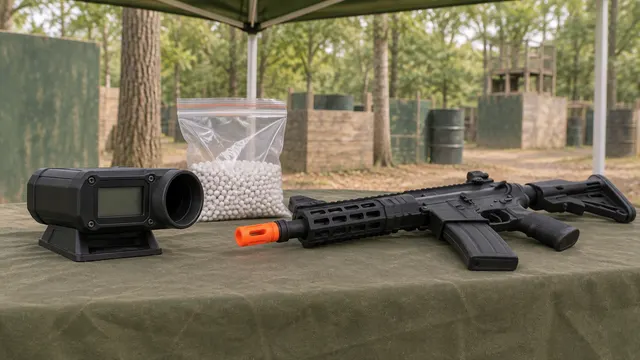
Airsoft FPS Limits Explained: Field Rules, Joules and MED
How airsoft fields set FPS and joule limits by gun type, why BB weight changes the reading, what minimum engagement distance means, and how chrono works.
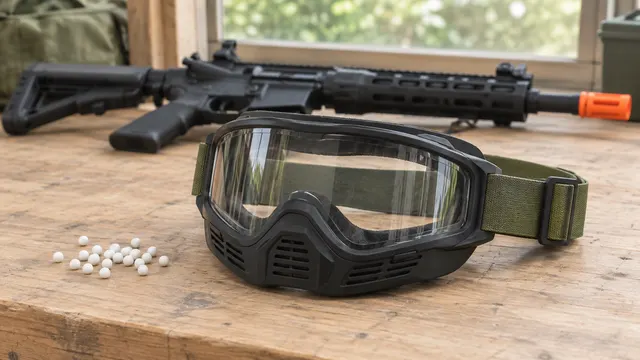
Airsoft Goggles: What ANSI Z87.1 Means and How to Choose
What the ANSI Z87.1 and Z87+ marks mean on airsoft goggles, where ASTM F2879 fits, full-seal vs mesh vs glasses, how to stop fog, and when to replace a pair.
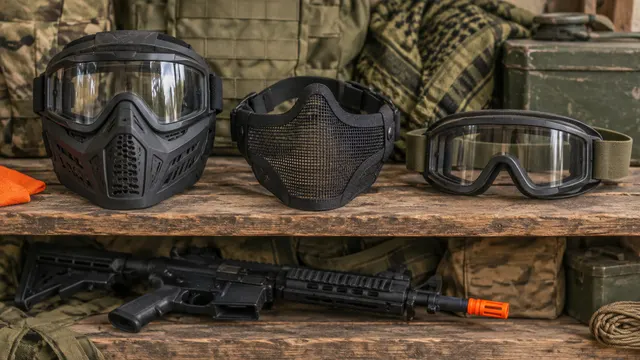
Airsoft Face Protection: Full-Face vs Mesh Lower Masks
Full-face masks vs goggles with a mesh lower mask: what each covers, field rules for under-18 players, why mesh never replaces goggles, plus ears and helmets.
Airsoft for Beginners: Everything to Know Before Your First Game
New to airsoft? How games work, booking a field, waivers and age, rated goggles, rentals, the chrono, hit calling, MED and etiquette, plus a first-day timeline.
Airsoft Gear Checklist: What to Buy First (and What to Skip)
A priority-ordered airsoft gear checklist: protection first, then gun, BBs, charger and case, then clothing and a rig, plus what to rent and what to skip early.
Night Airsoft Gear: Tracers, Lights and Staying Safe
What to bring to a night airsoft game: clear sealed goggles, a tracer unit and glow BBs, a red dead light, a light used by field rules, plus how tracers work.